Credit Repair vs. Credit Counseling vs. DIY: Which Is Right for You? (2026)
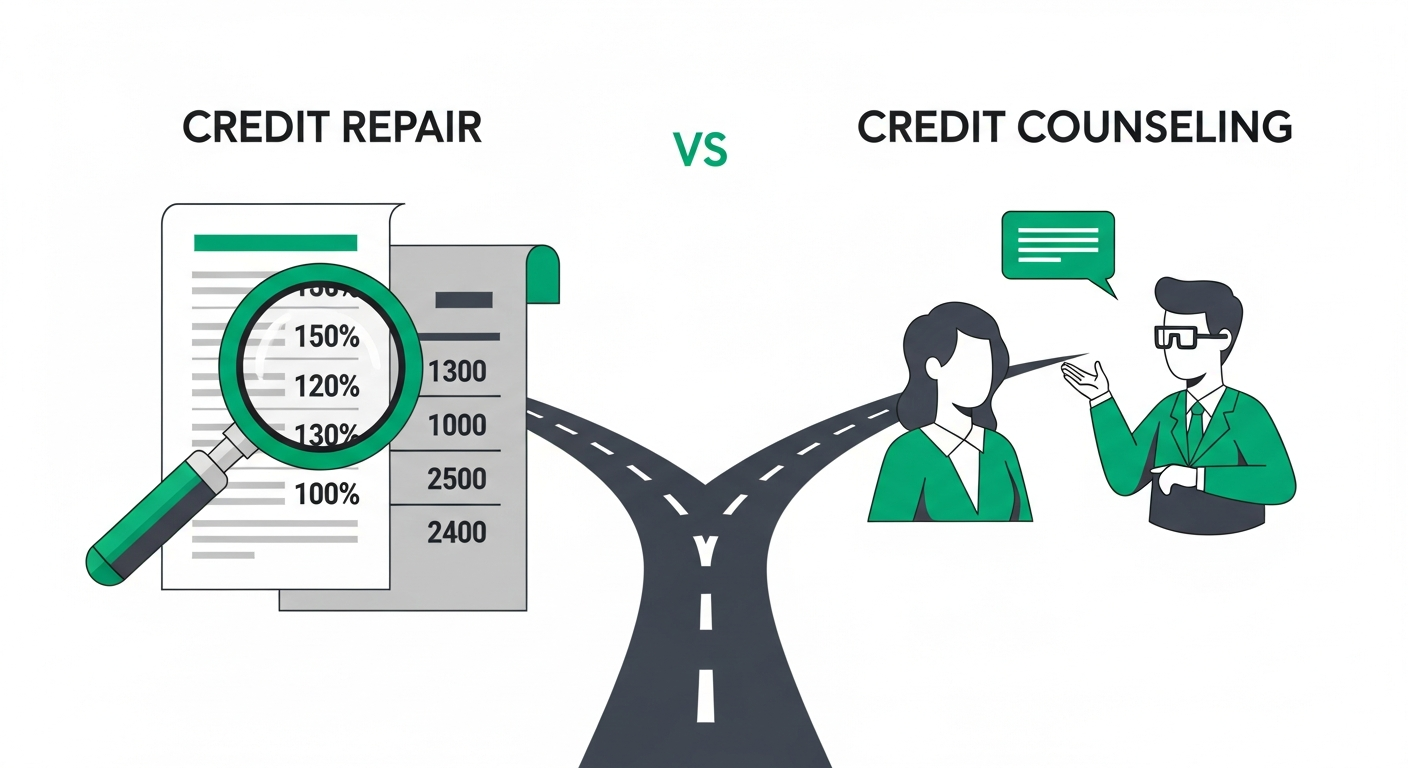
When your credit score needs work, you have three main paths: hire a credit repair company, work with a nonprofit credit counseling agency, or handle disputes yourself. Each approach solves a different problem, costs a different amount, and works on a different timeline. Choosing the wrong one wastes money and time.
This guide breaks down exactly what each option does, what it costs, and which situations each one is best for.
Understanding the Three Approaches
Before comparing them, let us be clear about what each one actually does — because the names are misleading.
Credit Repair: Disputing Errors and Inaccuracies
Credit repair focuses on removing inaccurate, unverifiable, or incomplete information from your credit report. It is based on your legal rights under the Fair Credit Reporting Act (FCRA), which requires that every item on your report be accurate and verifiable.
Credit repair does NOT erase legitimate debts. It challenges items that are reported incorrectly — wrong dates, wrong balances, unverifiable accounts, expired items, duplicates, and other errors.
Credit Counseling: Managing Existing Debt
Credit counseling focuses on helping you pay down legitimate debt through budgeting, financial education, and debt management plans (DMPs). Nonprofit credit counseling agencies negotiate with creditors to reduce interest rates and consolidate your payments into a single monthly amount.
Credit counseling does NOT dispute items on your credit report. It helps you manage and pay off the debt you owe.
DIY Disputes: Doing It Yourself
DIY means you handle the dispute process yourself — pulling your credit reports, identifying errors, writing dispute letters, mailing them, and following up. You have the same legal rights as any credit repair company. The question is whether you have the time, knowledge, and persistence to exercise them effectively.
Side-by-Side Comparison
Cost
| Approach | Typical Cost | Payment Structure | |----------|-------------|-------------------| | Credit Repair Company | $79 to $149/month | Monthly subscription, often with setup fee | | Credit Counseling (Nonprofit) | $0 to $50 setup + $25 to $75/month | Monthly fee on DMP only | | DIY Disputes | $0 to $50 | Cost of certified mail and copies | | AI-Powered Tools (like CreditShield) | $29 to $79/month | Subscription with tiered features |
Timeline
| Approach | Typical Duration | First Results | |----------|-----------------|---------------| | Credit Repair Company | 6 to 12 months | 45 to 90 days | | Credit Counseling (DMP) | 3 to 5 years | 6 to 12 months | | DIY Disputes | 2 to 6 months | 30 to 45 days | | AI-Powered Tools | 2 to 6 months | 30 to 45 days |
What Gets Fixed
| Approach | Removes Errors? | Reduces Debt? | Improves Habits? | |----------|----------------|---------------|-----------------| | Credit Repair Company | Yes | No | No | | Credit Counseling | No | Yes (via DMP) | Yes | | DIY Disputes | Yes | No | Somewhat | | AI-Powered Tools | Yes | No | Yes (guidance) |
When Credit Repair Is the Right Choice
Credit repair makes sense when your credit report contains errors or disputable items that are hurting your score. Situations where credit repair is most effective:
- Collections with reporting errors — wrong balance, wrong dates, missing validation
- Charge-offs with inaccuracies — balance exceeds credit limit, wrong date of first delinquency
- Late payments that were not actually late — payments within grace period, during billing disputes, or after loan modifications
- Unauthorized inquiries — hard pulls you did not authorize
- Identity theft items — accounts you did not open
- Expired items — negative entries past the 7-year reporting period that should have been removed automatically
- Duplicate accounts — the same debt reported by both original creditor and collector with errors
- Cross-bureau inconsistencies — information that differs between Equifax, Experian, and TransUnion
Red Flags in Credit Repair Companies
The credit repair industry has legitimate operators and outright scams. Watch for:
- Upfront fees before any work — the Credit Repair Organizations Act (CROA) prohibits this in most states
- Guaranteed removals — no one can guarantee a specific item will be removed
- Advising you to dispute accurate information — this is both unethical and ineffective
- Creating a "new credit identity" — suggesting you use a CPN (Credit Privacy Number) instead of your SSN is federal fraud
- No written contract — CROA requires a written disclosure of your rights and a three-day cancellation period
When Credit Counseling Is the Right Choice
Credit counseling makes sense when your credit problems stem from too much legitimate debt rather than reporting errors. Situations where credit counseling works best:
- High credit utilization — your credit card balances are close to or exceeding your limits
- Minimum payment trap — you can only afford minimum payments and the debt is not decreasing
- Multiple high-interest debts — you have several credit cards at 20%+ APR
- Difficulty budgeting — you need help creating and sticking to a financial plan
- Considering bankruptcy — credit counseling is a required step before filing Chapter 7 or Chapter 13, and a DMP may be a viable alternative
How a Debt Management Plan Works
- You meet with a counselor who reviews your income, expenses, and debts
- The counselor negotiates with your creditors for reduced interest rates (typically dropping from 20-25% to 6-10%)
- You make a single monthly payment to the counseling agency, which distributes it to your creditors
- The plan typically runs 3 to 5 years until all enrolled debts are paid off
DMP Impact on Credit
A DMP will show on your credit report as accounts being managed through a counseling agency. During the plan:
- Your enrolled accounts may be closed or frozen (which can temporarily lower your score due to reduced available credit)
- Your payment history during the DMP is reported as on-time (building positive history)
- After completion, the accounts show as "paid in full" which is a strong positive signal
Finding Legitimate Credit Counseling
Look for agencies affiliated with:
- National Foundation for Credit Counseling (NFCC)
- Financial Counseling Association of America (FCAA)
These organizations require member agencies to be nonprofit, employ certified counselors, and follow ethical standards. Avoid any "counseling" agency that charges large upfront fees or pushes debt settlement instead of debt management.
When DIY Is the Right Choice
DIY disputes make sense when:
- You have a small number of items to dispute (1 to 3) and the errors are straightforward
- You have time and patience for the dispute process (expect 30 to 90 days per round)
- You are comfortable writing formal letters and tracking correspondence
- Budget is your primary constraint — DIY costs only postage and copies
DIY Challenges
- Learning curve — understanding FCRA, FDCPA, and dispute procedures takes research
- Generic letters get ignored — bureaus process millions of disputes and template letters receive template responses
- Follow-up is critical — most successful disputes require 2 to 3 rounds of correspondence
- Legal nuances matter — knowing when to cite FCRA vs. FDCPA vs. FCBA vs. state law makes a significant difference in outcomes
The AI-Powered Middle Ground
AI-powered credit repair tools like CreditShield represent a fourth option that combines the legal knowledge of a credit repair company with the cost savings of DIY:
- Automated analysis — your credit report is scanned for errors, legal angles, and strategic opportunities in minutes
- Custom letters — each dispute letter is written from scratch with specific facts and legal citations, not fill-in-the-blank templates
- Multi-law coverage — disputes reference FCRA, FDCPA, FCBA, ECOA, FACTA, state laws, and the CARD Act as applicable
- Escalation roadmap — if initial disputes are denied, the system generates follow-up letters, CFPB complaints, and escalation correspondence
- Cost efficiency — a fraction of the cost of traditional credit repair companies
Making Your Decision: A Quick Framework
Choose credit repair (or AI-powered tools) if: Your credit report contains errors, and removing those errors would meaningfully improve your score. You do not necessarily owe all the debt being reported against you, or the amounts and dates are wrong.
Choose credit counseling if: Your credit report is mostly accurate, but you have too much debt and need help managing payments. Your score will improve as your balances decrease over time.
Choose both if: Your report has errors AND you have too much legitimate debt. Fix the errors first (faster score improvement), then address the debt through a DMP or on your own.
How CreditShield Helps
CreditShield gives you the power of professional credit repair without the professional price tag. Upload your credit report and CreditShield identifies every error, legal angle, and strategic opportunity — then generates unique dispute letters ready to send. No templates, no generic language, no guessing which law applies.
See what CreditShield finds on your report — your first analysis is free.
Ready to fix your credit?
CreditShield uses AI to analyze your credit report against 6+ federal laws and generate unique dispute letters automatically.
Try CreditShield FreeRelated Articles
How to Write a Goodwill Letter That Actually Works (2026 Guide + Examples)
Learn how to write an effective goodwill letter to remove negative marks from your credit report. Includes strategies, examples, and tips for getting creditors to say yes.
How to Dispute Late Payments on Your Credit Report (2026 Guide)
Learn how to remove late payments from your credit report using FCRA disputes, goodwill letters, and billing error challenges. Step-by-step guide with legal strategies.
How to Remove a Charge-Off from Your Credit Report (2026 Guide)
Complete guide to removing charge-offs from your credit report using FCRA disputes, pay-for-delete negotiations, and legal strategies that actually work.